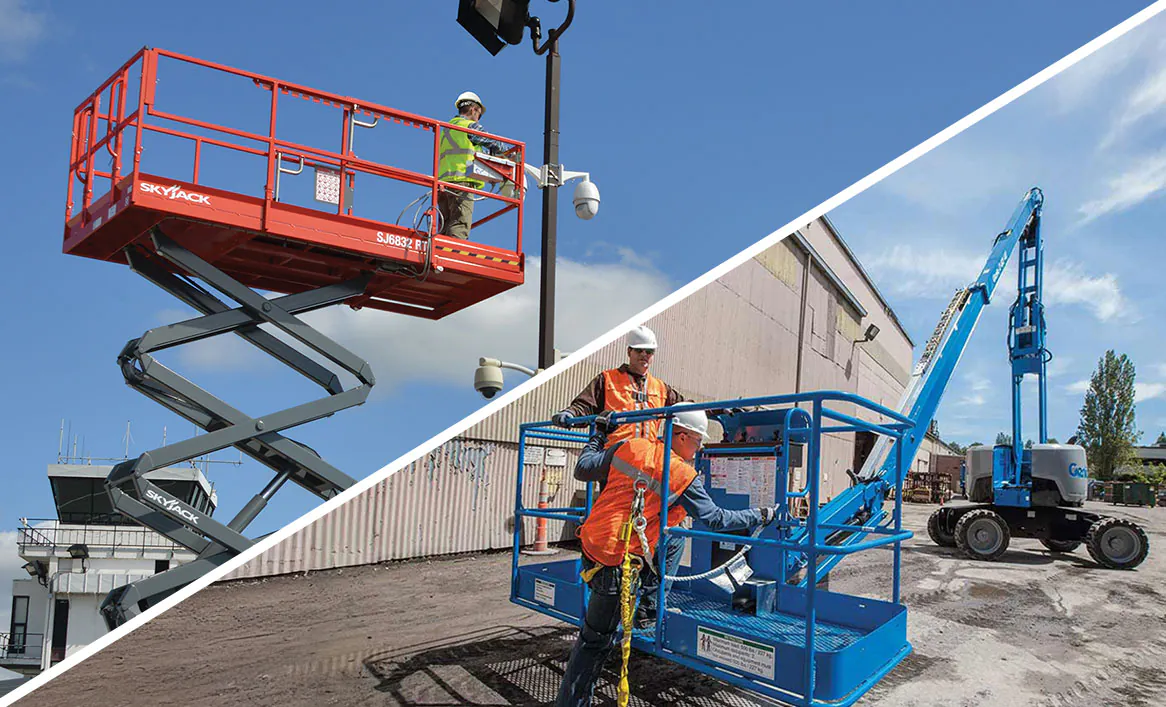
Every overhead work task poses a series of variables that must be fully thought out in order to choose the right aerial access method. How can the work area be accessed safely? What environmental conditions are in play? Is it a one-person or a multi-person task? Do we need to take up both tools and materials? These questions, and many more, typically come down to choosing between the most common aerial lift equipment styles: scissor lifts and boom lifts.
Aerial lift equipment is a category of powered industrial equipment used extensively in construction and maintenance work across practically all industries. Of all aerial lift equipment, scissor lifts and boom lifts are by far the most widely utilized.
- Scissor Lift – an aerial work platform design that features a fixed, caged worker platform mounted on top of a hydraulic scissor mechanism that can raise and lower the platform straight up in the air.
- Boom Lift – an aerial work platform design that features a similar fixed, caged platform to a scissor lift, but here mounted to a hydraulic jointed arm that can position the platform both up and away from the lift’s base (not just limited to vertical movement).
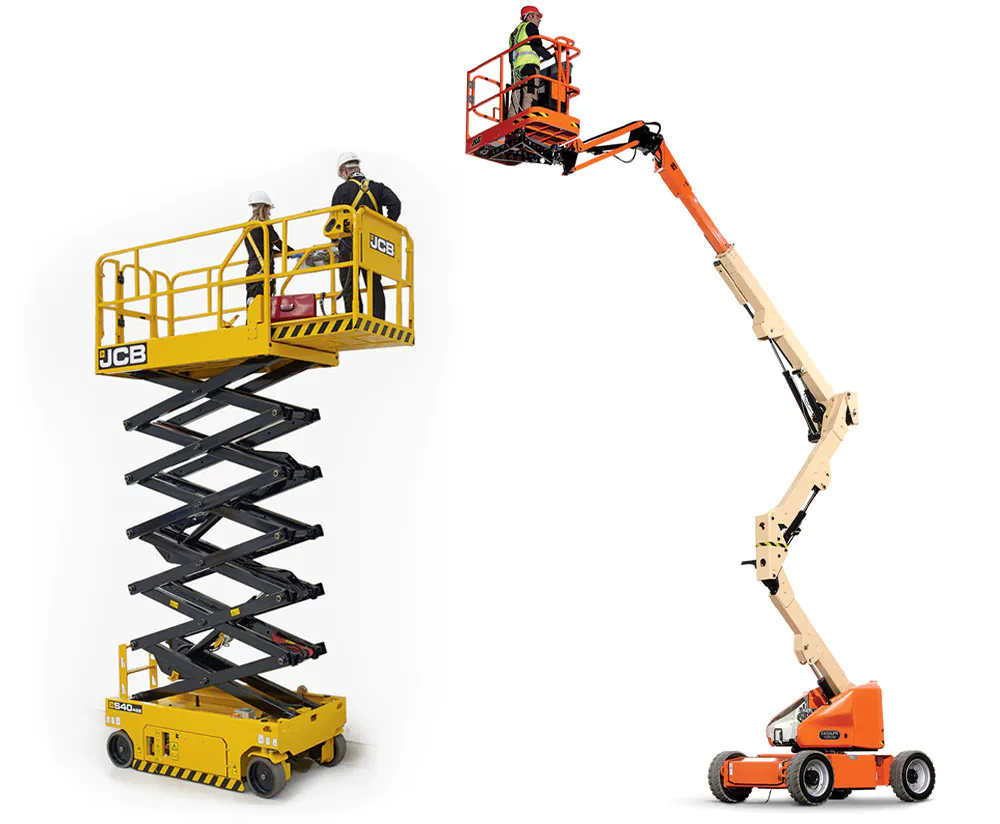
To help you better understand these options, let’s break down each lift style by its core features and provide a handful of common application examples.
Comparing Scissor Lifts and Boom Lifts by Their Capabilities
Here’s a quick overview of each lift’s core features and capabilities:
Scissor Lifts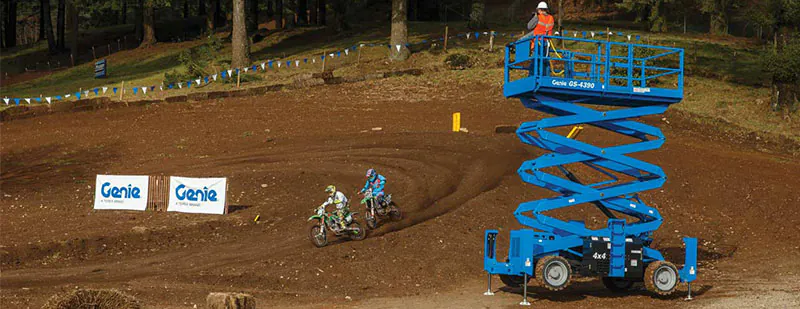 | Boom Lifts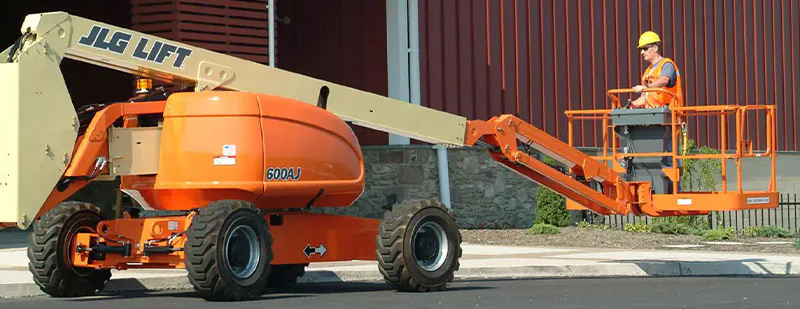 | |
|---|---|---|
| Overview | Scissor lifts provide vertical access to overhead work areas in a compact footprint | Boom lifts provide vertical and horizontal reach access to elevated work areas in powerful, highly dexterous manners |
| Key Features | Small size, high energy efficiency, lower cost, high weight capacity, and easy operation | High power, significant reach dimensions, precise platform positioning, and all-terrain stability |
| Working Environment | Indoor and Outdoor; mostly used indoors due to smaller size and greater maneuverability | Boom lift models are defined as telescoping boom (straight extending arm) and articulating (multi-point “knuckle” jointed arm) types |
| Model Variations | Scissor lift models are broken down into standard and all-terrain types | Boom lift models are defined as telescoping boom (straight extending arm) and articulating (multi-point “knuckle” jointed arm) types |
| Vertical Reach | 50′-75′ Max Height | 75′-190′ Max Height |
| Horizontal Reach | 0′-5′ Max Reach (via extendable platform only) | 70′-80′ Max Reach |
| Weight Capacity | Up to 1,500 lbs | Up to 800 lbs (1,000 lbs with restricted movement) |
| Payload | Can be configured for moderate hauling of tooling and materials | Can accommodate low tooling payloads, and are not recommended for hauling materials |
| Work Area | Large work deck for multiple workers | Small work deck for 1-2 workers |
| Terrain Handling | Most often configured for clean, smooth indoor surfaces with a two-wheel drive electric powertrain; all-terrain, gas/diesel and 4×4 models available | Most often configured for all-terrain, aggressive outdoor surfaces with a 4×4 gas/diesel powertrain; electric models available |
| Stability Features | Scissor lift stability is achieved through the weight of the battery pack and deployable stability bars | Boom lift stability is achieved through significant base weight counterbalance, often accompanied by deployable outriggers |
| Cost Basis | Scissor lifts are typically less costly to buy or rent, due to their simpler design | Boom lifts are typically more costly to buy or rent, due to their heavier-duty design and superior positioning capabilities |
| Operation | Scissor lifts are typically seen as easier to operate, given their simpler controls and reduced range of motion | Boom lifts are typically considered more difficult to operate, having many more control functions and overall larger size |
| Transportation | Scissor lifts are easier and less costly to transport, fitting on smaller trailers with lower weight capacities | Boom lifts are more intricate and costly to transport, requiring larger trailers with higher weight capacities |
| Special Considerations | Scissor lifts are very sensitive to uneven ground surfaces and external forces (such as wind), with the greatest risk of tip-over being when traveling with the platform raised | Boom lifts are very sensitive to amplifying motion, such as the catapult effect that occurs when traveling over uneven grades with the boom extended |
Example Applications by Industry
From the above table, we can see that deciding between boom and scissor lifts for a given application comes down to two main factors: the integrity of the working surface that the lift will operate on, and how the lift will need to maneuver to access the work area.
In most cases, scissor lifts are selected for clean, smooth, indoor applications that can be approached from directly underneath, whereas boom lifts are selected for more aggressive outdoor terrain applications approached “up and over” adjacent obstructions. But with that said, there are also many exceptions to the rule, as we’ll demonstrate with these examples pulled from various industries:
- Construction – construction trades tend to pick their preferred lift types by the phase of work, with boom lifts chosen more often for early outdoor phases such as steel framing and exterior painting, and scissor lifts chosen more for later indoor phases like electrical and HVAC (heating, ventilation, and air conditioning). Safety is a major component of construction work, which is why you’ll often see boom lifts selected where scissor lifts may have been fine, as well as oversized lifts where smaller lifts would have worked.
- Warehousing – warehouses most often use scissor lifts for indoor, limited-access maintenance, cleaning, and inventory checking applications. Scissor lifts mirror the same access patterns as warehouse forklifts and stock pickers, requiring only vertical access to goods stacked in racking. However, more automated warehouses utilize boom lifts for reaching into high-density storage modules and over ground-level equipment.
- Manufacturing – manufacturing applications tend to occur indoors and favor vertical access to maintain and service equipment, utilities, and process infrastructure elements directly overhead. However, reaching over equipment, conveyors, material stores, and process structures calls for boom lifts at times, as does servicing outdoor equipment and safely navigating across indoor sloped floors.
- Facility Maintenance – keeping commercial and industrial facilities running can take a full-time maintenance team performing ongoing service to the building’s key infrastructure, such as replacing light fixtures, cleaning gutters, washing windows, replacing rooftop HVAC filters, inspecting exhaust stacks, and much more. Facility maintenance usually calls for scissor lifts, consisting mainly of indoor tasks along with outdoor tasks occurring on flat, solid concrete designed for maintenance access.
- Grounds Keeping – think of groundskeeping work as a combination of landscaping and nature-based maintenance, occurring outdoors in commercial and industrial settings such as business parks, major developed sites, public civic centers, shopping malls, golf courses, and any other establishment that has big trees, bushes, ivy walls, water fountains, and similar organic features. Boom lifts dominate these applications, as most require all-terrain, reach-type accessibility.
- Multimedia / Entertainment – concert halls, theaters, theme parks, movie sets, and countless similar multimedia applications routinely use scissor lifts to access overhead gear such as lighting, sound, camera, and effects systems. However, boom lifts are used in the largest venues and outdoor locations for safety and stability, as well as in locations with significant floor slopes, fixed seating, tiered loge seating, elevated control rooms, and extended balconies.
- Events – trade shows, job fairs, sports games, seminars, music and art festivals, county fairs, traveling circuses, and so many more types of produced events involve both scissor and boom lifts to get set up. Event applications follow the same general concepts as the rest of our examples, with indoor events favoring scissor lifts and outdoor events favoring boom lifts.
We hope that this discussion has been helpful for your commercial material handling and operational needs. Fairchild Equipment is the Upper Midwest’s premier Material Handling Equipment and Service resource, with headquarters in Green Bay, Wisconsin, and numerous locations ready 24/7 to serve your needs throughout Wisconsin, Minnesota, North Dakota, Michigan’s Upper Peninsula and Northern Illinois. For more information or to discuss which equipment solution might be best for you, please call us at (844) 432-4724 or send us a message.