Making an Informed Pallet Racking System Decision for Your Warehouse Expansion
In all our experience serving distribution, manufacturing and warehousing businesses, we’ve never come across a project where there was only one possible racking solution that could fulfill a customer’s objectives. Instead, every project always comes down to a decision between multiple options that must balance commercial, operational, and technical factors.
Between any two near-identical applications, one business may favor higher performance despite higher maintenance costs, whereas another business may favor minimal investment costs at the slight expense of flexibility. Each business may ultimately end up selecting a different racking solution, even though both perform the same storage functions. That’s the nature of warehouse design, which makes the need for buyers to fully understand their options and decision points so critical.
For you to make an informed decision on storage systems for your next warehouse expansion or retrofit, we’d like to help build your familiarity with the most common pallet racking styles and their key design points below.
Pallet Racking System Options
We’ll next run through the main options available for industrial warehousing and material handling pallet storage:
Single Selective Pallet Racking
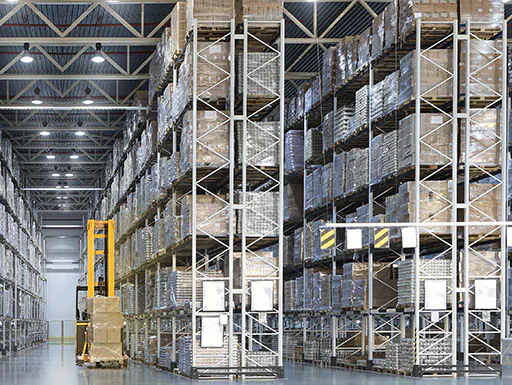
Single Selective (also known as Single Deep) pallet racking is widely recognized as the most basic entry-level racking design, offering direct picking of every pallet stored. Single selective racking is the most cost effective but can often require the most space out of all options, as forklift aisles are needed to access each pallet position. Because every pallet position can be picked independently, inventory flexibility is very high.
Double Selective Pallet Racking
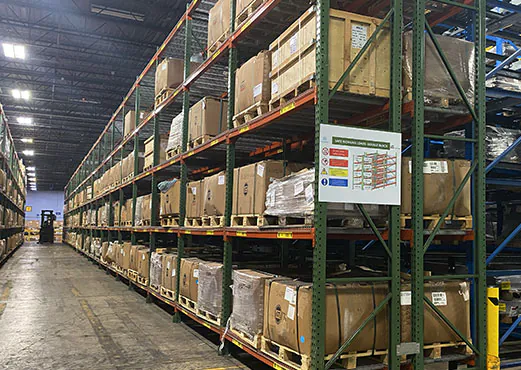
Double Selective (also known as Double Deep) pallet racking stores two pallets deep per aisle facing. This solution doubles storage density over single selective racking by reducing aisles, but requires special double reach-type forklifts to place and pick pallets in the rear position. Inventory flexibility is reduced as well, since the front pallet must be moved to access the rear pallet in each bay.
Push Back Pallet Racking
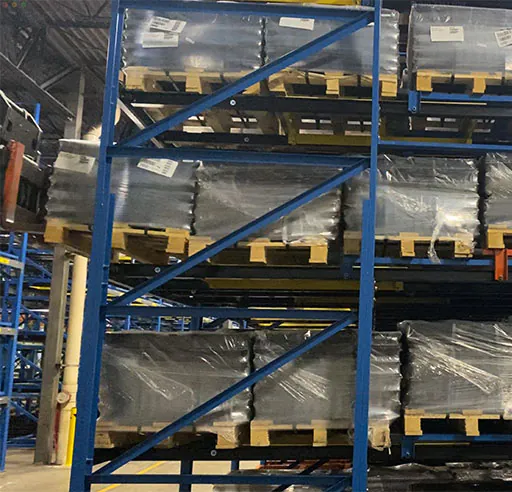
Push Back pallet racking further increases storage density by holding multiple pallets in deep lanes (usually of 2-5 pallets), each resting on a structural cart that rolls deeper into the lane as a forklift pushes back each new pallet. When a pallet is removed, the carts slide forward to present the next pallet in line to the aisle face. In this way, push back racking offers LIFO (Last In First Out), also sometimes called FILO (First In Last Out), inventory access, since the first pallet stored is pushed all the way to the back of the lane and cannot be accessed until all later pallets are removed.
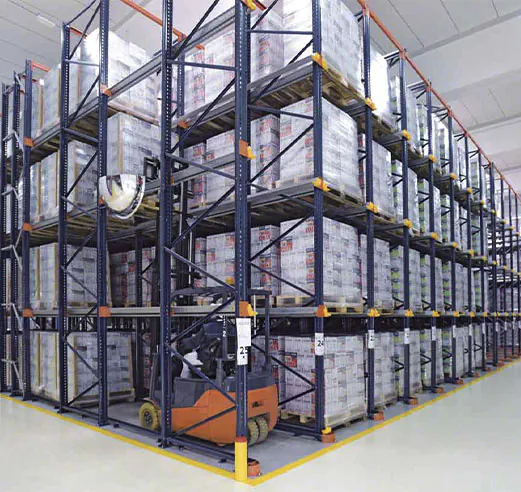
Drive In / Drive Through Pallet Racking
Drive In and Drive Through racking are both deep lane storage solutions in which pallets are placed directly by forklifts in long rows, often between 10 and 20 pallets deep. While forklifts physically drive into both racking styles, drive-in racking is picked and pulled from the same side (LIFO), whereas drive-through racking is picked and pulled from opposite sides (FIFO or First In First Out). Both options offer very high density and space efficiency for bulk product storage with lower selectivity, but require more active management of potential forklift impacts and maintenance.
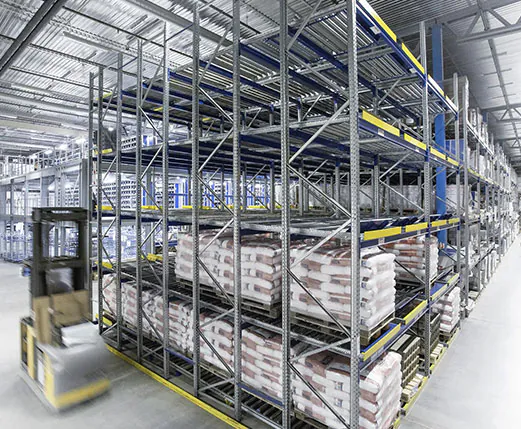
Gravity Flow Pallet Racking
Gravity Flow (also known as Pallet Flow) racking functions similarly to drive-through racking, in that pallets are loaded from one side and picked from the opposite side in a FIFO fashion. However, gravity flow racking uses mechanical rollers that allow pallets to “flow” to the output side under their own weight, eliminating the need for forklifts to drive into the racking structure. Flow racking is great for space-efficient, automatic inventory movement and sequencing while also separating input and output traffic.

Mobile Pallet Racking
Mobile pallet racking refers to motorized selective racking structures that mechanically move themselves to collapse into high-density storage or split apart to create access aisles as needed. Mobile racking offers great storage efficiency for constrained spaces but are more costly and intricate to install.
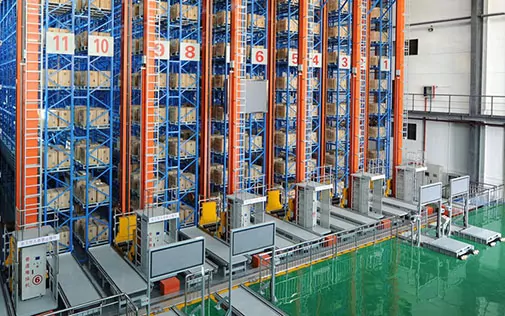
Automated Pallet Racking
There are many variations of automated pallet racking solutions available, all of which target replacing human and forklift traffic with mechanized pallet handling to obtain the highest density, efficiency, and throughput of any racking system. Automated solutions are differentiated by their layout and pallet handling method, with the most common systems using shuttle carts, cranes, and elevators.
Key Considerations for Choosing a Pallet Racking System
Now that you’re familiar with the main pallet racking systems available, let’s review the key decision points involved in selecting a pallet racking system for your applications:
- Pallet Load Compatibility – not all pallet loads are created equal (especially in terms of weight, dimensions, stability, and uniformity) which requires critical comparison against each racking style’s sensitivity to format deviations. Single and double selective racking offer the most flexibility to off-shaped pallet builds, overhanging cases, and dimensional variations, whereas fixed-rail (deep lane) and automated systems require much greater consistency.
- Selectivity & Product Mix – selectivity refers to how much access is needed to your inventory, with maximum selectivity meaning that any given pallet can be directly picked without the need to handle any other pallet. For max selectivity of a high number of unique SKUs, single selective, mobile, and fully automated racking are ideal. For low selectivity of high volumes of a few SKUs (i.e., many pallets of the same product), push-back, drive-in, and drive-through racking work great.
- Inventory Flow – inventory flow describes the sequence or order of material movements required by your products. For example, perishable products are usually stored in a FIFO flow pattern, where the first products put into storage are the first to be picked to minimize storage time (with pallet flow and drive-through racking). In other cases, a LIFO flow pattern may be desired to sell more recent stock at higher current prices over legacy stock (with drive-in and push-back racking).
- Storage Flexibility – for warehouses with highly variable product schemes, throughput rates, and storage durations, storage flexibility becomes a main design factor to weigh against storage density. Businesses that need maximum flexibility to store and pick any product at any time tend to choose either single selective, mobile, or fully automated racking systems. With that said, most businesses need “high” flexibility instead of “maximum” flexibility, and are best served by installing a mixture of racking systems under one roof.
- Available Space – the amount of both area and vertical space available for a racking solution directly influence a project’s cost, and often present the greatest limitation when reviewing storage options. Very large available spaces have the freedom to choose lower-cost racking designs like single and double selective, whereas smaller spaces prefer to increase density towards deep lane and automated systems which naturally increases costs.
- Storage Environment – lastly, a warehouse’s storage environment also influences ideal racking options in three important ways: maintenance, reliability, and safety. Low volume cold storage, outdoor yard storage, and other harsh environments prefer simple, static storage systems due to their lower costs, maintenance, and risks. However, high volume cold or aggressive material storage often jump straight to fully automated solutions, to completely remove humans from these spaces and maximize performance.
While these general guidelines are intended to help narrow down and prioritize selection criteria for your pallet racking project, they are not meant to replace professional advice from an experienced racking design expert. There are additional considerations to review including forklift compatibility, management software packages, future growth expectations, and much more. We recommend that buyers use the above list to organize your project’s objectives – including budget and timing expectations – and then reach out to our warehouse design consulting team to collaborate on an ideal solution.
We hope that this discussion has been helpful for your commercial material handling and operational needs. Fairchild Equipment is the Upper Midwest’s premier Material Handling Equipment and Service resource, with headquarters in Green Bay, Wisconsin, and numerous locations ready 24/7 to serve your needs throughout Wisconsin, Minnesota, North Dakota, Michigan’s Upper Peninsula and Northern Illinois. For more information or to discuss which equipment solution might be best for you, please call us at (844) 432-4724 or send us a message.