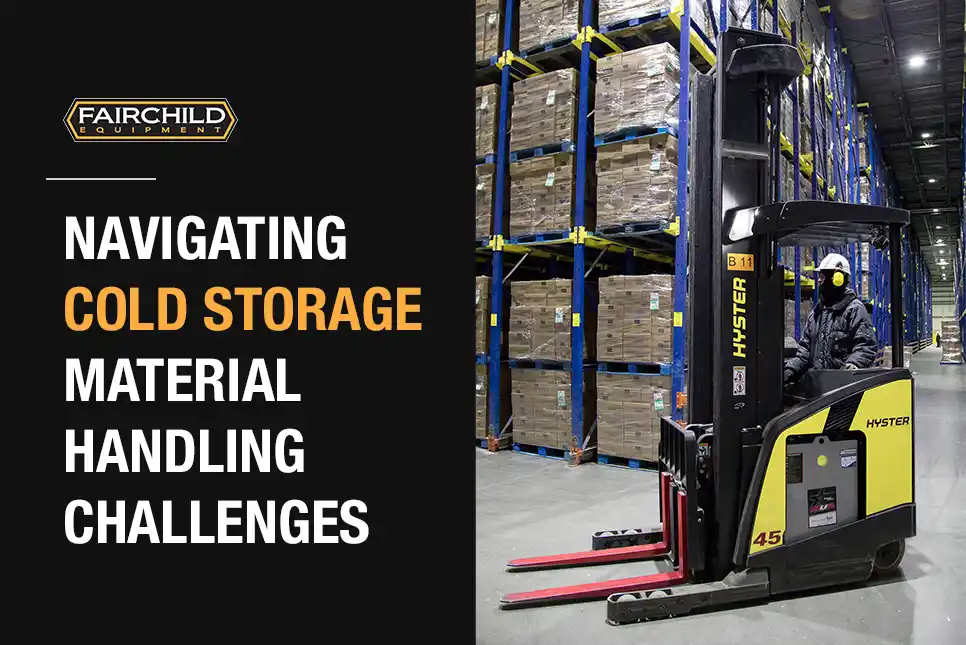
A large swath of the industrial manufacturing and distribution arena handles perishable goods that can only be stored in temperature-controlled spaces described as cold storage warehouses. Practically all cold storage operations involve forklifts to move product containers (very often pallets) into and out of pallet racking, work-in-progress (WIP) staging, truck and rail containers, automated storage (AS/RS) systems, and similar applications.
Standard forklifts and other material handling equipment naturally don’t do well in cold storage spaces due to the simple fact that low temperatures are especially aggressive on both equipment and operators. In fact, many would call cold storage a step beyond “heavy duty”, given just how strenuous these environments can be.
To get a better sense of the temperatures in play, let’s define the common categories of cold storage applications:
- Refrigerated Storage – between 32°F and 40°F, this is the industry-standard range for short-term storage of perishable products such as dairy, produce, beverages, and pharmaceuticals.
- Specialty Refrigerated Storage – between 40°F and 60°F, used for products that are sensitive to colder temperatures, including certain fruits, vegetables, flowers, and specialty chemicals.
- Frozen Storage – between 0°F and -10°F, used for frozen foods, prepared meals, ice cream, and any other products needing long-term preservation.
- Deep Freeze Storage – between -10°F and -25°F, used for animal proteins such as beef, poultry, and seafood, as well as for certain pharmaceutical and biotechnology products.
- Controlled Atmosphere (CA) Storage – between 32°F and 34°F, used primarily for fresh produce storage where atmospheric composition is artificially altered to slow respiration and inhibit ripening.
The Unique Challenges of Cold Storage Forklift Operations
Next up, let’s share the most significant challenges presented by cold storage applications below (keep in mind that as temperatures drop, these effects become more severe):
- Operator Comfort & Fatigue – working for extended periods in cold environments increases operator fatigue, discomfort, and physical strain, reducing concentration and reaction times.
- Condensation, Moisture Exposure & Traction – transition spaces between cold and ambient zones are prone to condensation, which pose equipment corrosion risks and slippery surface safety hazards.
- Mechanical & Hydraulic Challenges – cold temperatures inhibit the performance of hydraulic fluids, lubricants, hoses, and seals throughout a forklift, which often lead to premature component failures.
- Equipment Wear & Tear – cold storage forklifts tend to wear faster and more prominently due to thermal cycling (constant temperature changes), exposure to moisture, and general low-temp degradation.
- Battery Performance – all forklift batteries discharge faster, charge slower, offer lower power, and are highly susceptible to failures at lower temps.
- Visibility Challenges – temperature transitions cause windshields, mirrors, cameras, and operator eyewear to fog or frost over, leading to work interruptions, limited visibility, and risk to nearby pedestrians.
- Exposure Limits & Shift Management – forklift operators can only work at low temperatures for a short amount of time, which requires managing work-rest rotations to maintain their alertness and physical health.
- Seasonality & Demand Surges – as many cold storage applications are tied to seasonal products, the challenges above can be squeezed into short periods of high-intensity work, compounding hazards further.
What makes these challenges particularly difficult is that they rarely exist on their own. Most often, one problem will arise and act as a catalyst for others. In fact, some of the worst accidents we’ve heard of involved a forklift with multiple cold-caused deficiencies being operated by a cold-impaired driver. This is why watching and solving for these types of issues is so critical.
Best Practices & Recommended Forklift Features for Cold Storage Applications
Cold storage applications are indeed uniquely taxing on equipment and operators, but there are viable solutions up to the task. Clearly, safety is the paramount goal when addressing cold storage warehousing challenges – or any warehousing challenges, for that matter. To best protect operators and assets, fleet managers should always consider the following suggestions and best practices:
- Equipment Selection – any forklift to be used in a cold storage environment must be specified accordingly, as ambient forklifts will not work. In particular, look closely at a lift’s specifications for temperature, duty cycle, chassis materials and coatings, serviceability, moisture drainability, and warranty coverage.
- Component Ratings – beyond the forklift itself, ensure that each lift’s critical components are rated for the environment. Examples: hermetic seals on electronics, IP-rated wiring and enclosures, rigid high-traction tires, corrosion-resistant materials and treatments, and severe-duty ratings.
- Cabin Comfort – an operator’s level of comfort directly affects their ability to make safe, productive decisions, provided by forklift features such as enclosed cabins, onboard cabin heaters, ergonomic seating, and ample visibility aids (for example, mirrors, cameras, lighting).
- Low-Temperature Seals and Fluids – all hydraulic fluids, greases, seals, elastomers, and lubricants on a cold storage forklift must be specified for the specific temperature range expected, and must be maintained and replaced on a more frequent cadence.
- Batteries & Charging – cold storage forklifts must utilize appropriately rated batteries, incorporate onboard battery heaters, and recharge often in ambient temp spaces. Battery technologies frequently evolve too – lithium-ion batteries with integrated heating and intelligent management systems are the current best option.
- Preventative Maintenance – cold storage forklifts need heightened maintenance attention, including both machine inspections and preventative maintenance. Maintenance should heavily focus on batteries, hydraulics and fluids, lubrication, tires, brakes, condensation/moisture indications, and structural conditions.
- Operator Training – operators must receive extensive training specific to cold storage environments, such as
:safe operation on cold surfaces, managing fog-up at temperature transition zones, battery power and capacity expectations, self-assessing behavioral and cognitive impacts, and recognizing cold-space hazards.
Ultimately, the colder the environment, the more critical these considerations become. Across all temperatures though, cold storage warehouses present some of the most demanding conditions in all of industrial material handling. But for every challenge there are ample solutions that make cold storage applications just as safe and effective as any other application, so long as fleet managers adapt their equipment and operators accordingly.
We hope that this discussion has been helpful for your commercial material handling and operational needs. Fairchild Equipment is the Upper Midwest’s premier Material Handling Equipment and Service resource, with headquarters in Green Bay, Wisconsin, and numerous locations ready 24/7 to serve your needs throughout Wisconsin, Minnesota, North Dakota, Michigan’s Upper Peninsula and Northern Illinois. For more information or to discuss which equipment solution might be best for you, please call us at (844) 432-4724 or send us a message.